At StrawberrySocial, we recently presented our latest quarterly social media briefing to clients, exploring some of the biggest shifts affecting platforms, audience behaviour, online communities and digital strategy.
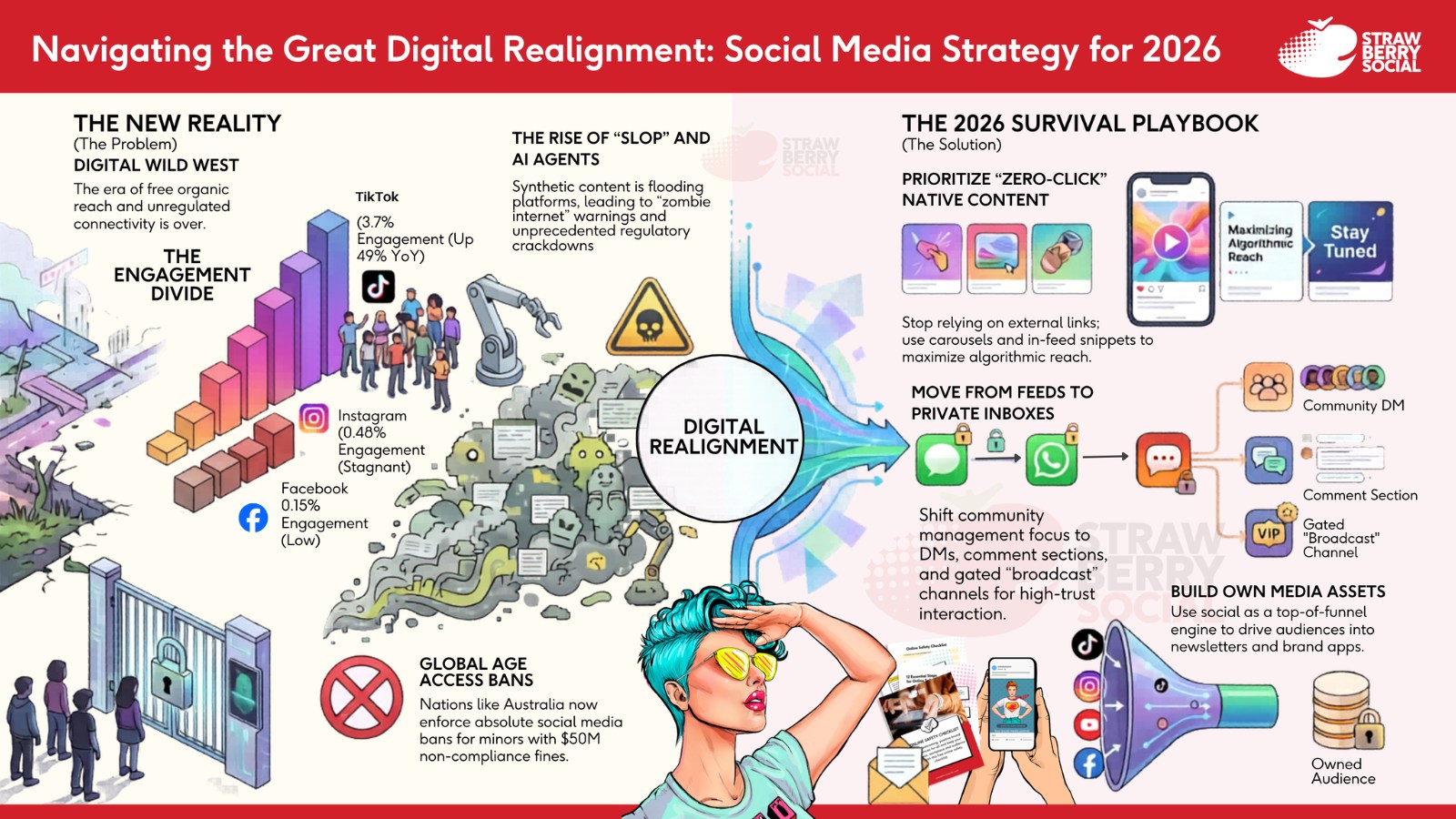
The era of open platforms, easy organic reach and relatively frictionless audience growth is fading fast. In its place, we are seeing tighter regulation, more closed ecosystems, declining outbound visibility, AI-generated content at scale and audiences increasingly retreating into smaller private spaces.
The old digital playbooks are becoming less reliable.
Here are five trends shaping what comes next, and the strategic pivots organisations should be thinking about now.
1. Age assurance and stricter platform controls
Governments are tightening rules around how children and young people access social media, moving beyond basic self-declared age checks towards far stricter enforcement models.
Australia became the first country to introduce nationwide social media age restrictions for under-16s, with other countries now exploring similar measures amid growing pressure around child safety and platform accountability online.
For brands, this matters because the assumption that platforms will simply handle compliance on your behalf is becoming increasingly risky.
Youth-focused campaigns, audience targeting and data collection practices are all likely to face greater scrutiny over the next few years.
What this means for marketers
Organisations can no longer rely on self-reported age data or assume platforms alone will manage compliance risks.
For marketing teams, this means:
- greater scrutiny around audience targeting
- increasing pressure on behavioural tracking practices
- stronger emphasis on contextual advertising
- more careful consideration of youth-oriented campaigns
The broader direction of travel is clear: platforms are becoming more regulated, more controlled and less open.
2. Social platforms are becoming entertainment feeds
Many social platforms no longer prioritise social interaction in the traditional sense.
Instead, they increasingly function as algorithmic entertainment systems where users consume content selected by recommendation engines rather than simply seeing posts from people they follow.
This helps explain why some brands are seeing strong reach but weak click-throughs or low meaningful engagement.
At the same time, engagement patterns between platforms continue to diverge sharply. Recent benchmark research found average engagement rates on TikTok significantly outperform those seen on Facebook Pages, reinforcing how differently platforms now behave.
What this means for marketers
- Stop treating social posts purely as traffic drivers
- Build content that delivers value inside the platform itself
- Prioritise native formats such as:
- LinkedIn video
- Instagram carousels
- Short-form vertical video
- Platform-native storytelling
- Assume fewer users will leave the app to visit your website
The old “post a link and drive clicks” model is becoming steadily less effective.
3. Platforms want to keep users inside their ecosystems
The major platforms are heavily incentivised to keep attention, activity and transactions within their own environments.
That means:
- Reduced visibility for outbound links
- Greater emphasis on native publishing
- Growing subscription and paid visibility models
- Increased dependency risks for brands
This trend has been building for years, but many marketers are now seeing the practical impact more clearly in analytics and campaign performance.
What this means for marketers
Social media should increasingly be treated as a top-of-funnel discovery layer rather than the centre of a digital strategy.
The long-term priority should be strengthening owned assets, including:
- Email newsletters
- CRM databases
- Communities you control
- Your website
- First-party audience relationships
Brands that rely entirely on rented platforms are becoming increasingly vulnerable to algorithm shifts and declining organic visibility.
4. Audiences are retreating into smaller, private spaces
Exhausted by toxic public discourse, platform fatigue and growing volumes of AI-generated content, many users are retreating into smaller, more private digital spaces.
In many cases, the most valuable conversations now happen away from the public timeline.
Instagram has increasingly emphasised private sharing signals as part of its recommendation system, with head of Instagram Adam Mosseri publicly describing “sends per reach” as one of the platform’s most important ranking indicators. This reflects a wider shift towards content that audiences actively share or save, rather than simply passively liking.
What this means for marketers
Community management matters more than ever.
Brands should pay closer attention to:
- Comment sections
- DM engagement
- Audience relationships
- Human interaction quality
- Smaller community experiences
In practice, content that is genuinely useful, relatable or emotionally resonant is increasingly more likely to be shared, saved and discussed than content designed simply to generate quick reactions.
5. Autonomous AI Agents and the “Agentic Web”
AI is no longer simply helping people write captions or generate images.
We are now seeing large-scale growth in synthetic content across search, social media and online publishing more broadly.
At the same time, early experiments involving autonomous AI agents interacting across networks and platforms are beginning to emerge, raising new questions around moderation, authenticity and synthetic engagement.
For brands, this creates new challenges around authenticity, moderation, trust and differentiation.
What this means for marketers
As AI-generated content becomes more common, genuinely human qualities become more valuable.
Brands should prioritise:
- Real expertise
- Original perspective
- Lived experience
- Trust
- Credibility
- Distinctive brand voice
- Recognisable people and personalities
The brands most likely to stand out over the next few years are unlikely to be the ones producing the highest volume of content.
They will be the ones producing content that feels real, useful and difficult to imitate.
The bigger picture
In the short term, organisations need to adapt to:
- stricter age assurance expectations
- algorithm-first content distribution
- declining outbound link performance
- increasingly closed platform ecosystems
Longer term, the challenge becomes more fundamental.
As AI-generated content floods digital platforms, competitive advantage will increasingly come from:
- trust
- credibility
- originality
- human perspective
- audience ownership
- genuine community
In a digital environment increasingly shaped by automation and synthetic media, humanity itself may become one of the most valuable brand assets of all.


 May 12, 2026

 Share This Post